






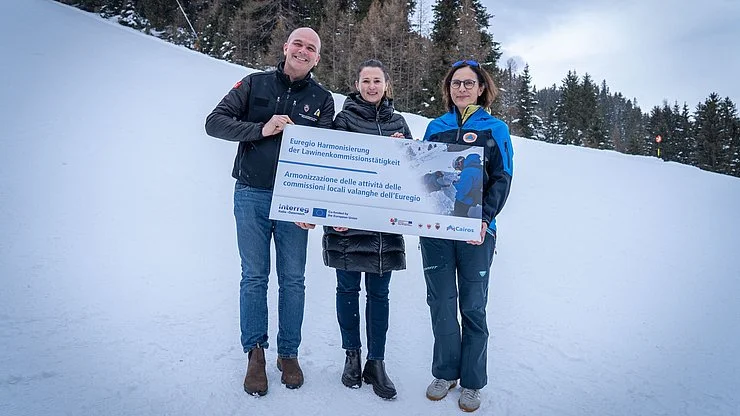
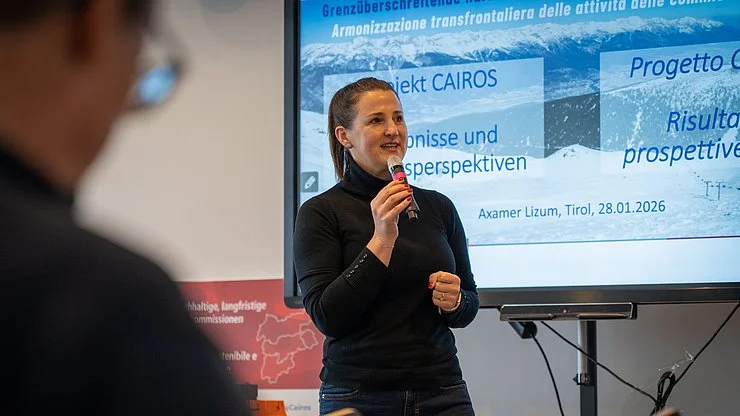
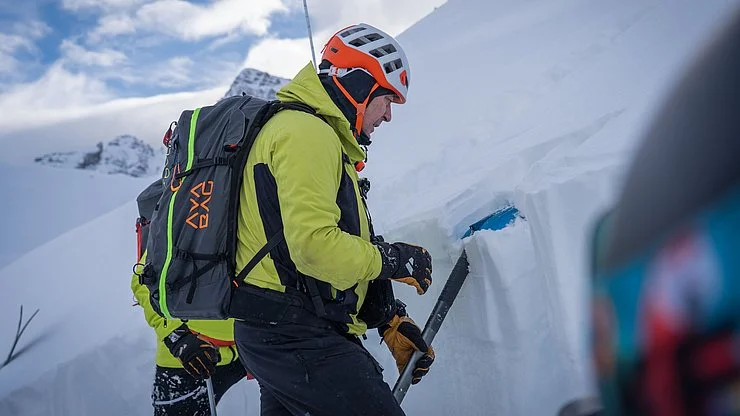
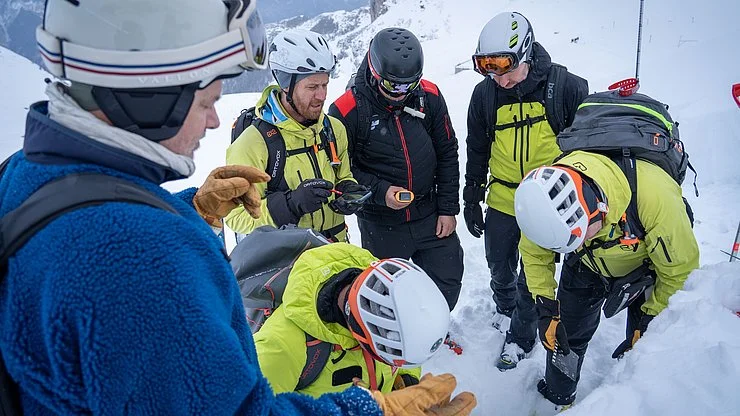
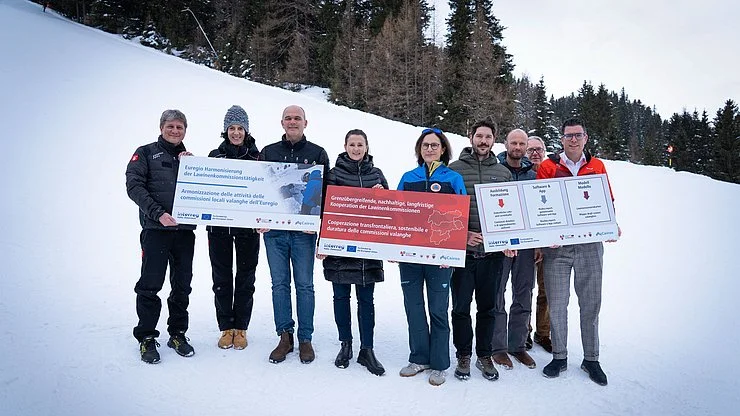
From EU project to regular operation: Regional Councillor for Security of the Region of Tyrol Astrid Mair and civil protection leaders from Bolzano and Trento presented unified training and digital tools for avalanche commissions.
More safety from avalanches in Tyrol, South Tyrol and Trentino: this is the objective of the Euregio project Cairos. After two years, the project, funded through the EU’s Interreg programme, has now been completed and will be adopted into regular operations by the institutions responsible for the avalanche commissions in the three regions. On Wednesday, 28 January, Tyrol’s Regional Councillor for Security Astrid Mair, the Director of the Office for Meteorology and Avalanche Warning, Michela Munari from South Tyrol, the Director General for Civil Protection, Forestry and Fauna, Stefano Fait from Trentino, as well as experts from the three Euregio regions, took stock of the results in Axamer Lizum above Innsbruck and looked ahead to future areas of application.
Joint training and software
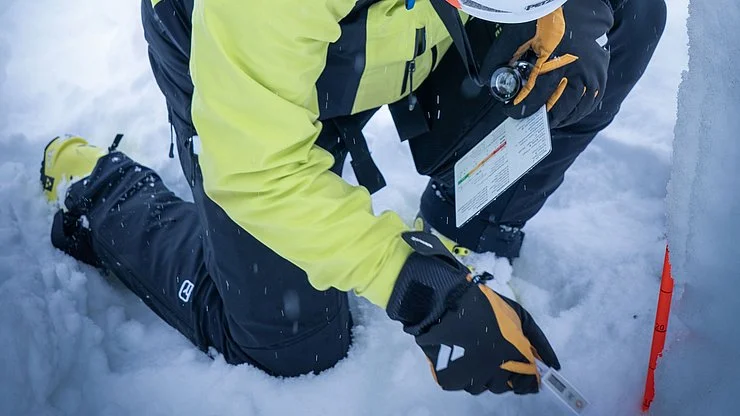
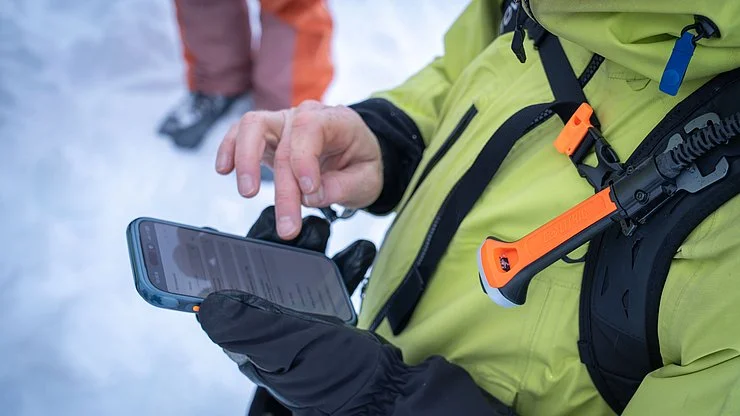
Key elements include joint training with coordinated learning content, newly developed avalanche scenario maps, and a new software platform including an app based on the principle “Observe, Assess, Act”. From the winter season 2026/2027 onwards, these will be fully operational. Thanks to the app, members of the avalanche commissions can assess the situation more easily, record observations directly on site via smartphone, prepare assessments and communicate recommended measures – such as road closures – to decision-makers.
Simpler, more efficient, safer: example with strong demand
Regional Councillor Mair pointed to the special responsibility of the avalanche commissions in all Euregio regions: “With Cairos, it has been possible to develop uniform cross-border standards for the commissions and to provide them with a genuine multifunctional tool through the new software. This makes their complex tasks simpler, more efficient and safer. Avalanches know no borders – therefore safety requires joint, cross-border solutions. Cairos shows how such cooperation can concretely help protect lives.”
Michela Munari highlighted the responsibility borne by commission members when advising mayors in their decision-making:
“Thanks to Cairos, we were able to share knowledge and, on that basis, develop joint instruments for different areas facing similar challenges.” The Euregio thus serves as a concrete example of effective cooperation. In fact, there have already been enquiries from other Alpine regions – including Salzburg and Carinthia.
Using the example of widespread snowfall across the Alpine region, Stefano Fait illustrated the importance of the new Cairos instruments: “Colleagues from other Italian regions were astonished by the overview that Trento and South Tyrol alone had across their entire territory thanks to the data collected by the avalanche commissions. Cairos is an example of how natural hazards such as avalanches can be managed – hazards with which people in the Alpine region will always have to live.”
Additional information
Cairos: details and three questions for the project managers
More than 2,000 commission members across the Euregio
Across the Euregio regions, more than 2,000 largely voluntary members are currently active in 346 commissions. In the municipalities concerned, they assess avalanche risk and primarily advise mayors as the highest civil protection authority at municipal level (detailed figures are available in the download section).
Regional and international recognition
Cairos has been presented 26 times within the Euregio and beyond. Among other venues, the project managers presented it at the world’s largest scientific conference on snow and avalanches, the “International Snow Science Workshop”. In addition, three publications appeared in specialist journals. In seven meetings with pilot commissions, closer cross-border cooperation was tested and further developed.
Three questions for the project managers
What are the key objectives of the joint training programme?
Alice Gasperi, Department of Civil Protection, Forestry and Fauna, Autonomous Province of Trento:
“Over the two years of the project, we created a joint training structure. It results in coordinated course concepts across all partner regions and integrates common teaching and learning materials. These contents will be made publicly available via the ‘Snow.institute’ platform.”
What are avalanche scenario maps?
Jakob Schwarz, Office for Meteorology and Avalanche Warning, Autonomous Province of Bolzano – South Tyrol:
“The avalanche scenario maps, also referred to as avalanche maps, can be updated daily thanks to the avalanche bulletin of the already well-known ‘Lawinen.report’. They form an important basis and support tool for the avalanche commissions in their decision-making.”
How does the new joint software with app work?
Michael Winkler, Department of Crisis and Hazard Management, Region of Tyrol:
“As part of the Cairos project, we developed a new joint software platform together with a dedicated app. It will be called ‘Risiko.report’ and will replace the current systems. The aim is to simplify information gathering, decision-making, documentation and communication between the commissions and the decision-makers.”