





Direkt zum Seiteninhalt
Aktuelle Sprache:
  • Switch to language en
  • Passare alla lingua it
Leicht Lesen
Land Tirol - Zur Startseite

Schnellnavigation und Seitenhilfe

Schnellnavigation über Kurztasten

Alt-Taste (Firefox: Zusätzlich mit Umschalttaste) + Kurztaste

  • Zum Inhalt - Kurztaste 1
  • Zur Hauptnavigation - Kurztaste 2
  • Zu den Kontaktdaten der zuständigen Organisationseinheit - Kurztaste 3

Barrierefreiheit

  • Selbstbeschreibung unserer Barrierefreiheit
  • Glossar
  • Inhalte in Leicht Lesen
  • Gebärdensprachvideos
Menü schließen
  • Startseite
  • Bürgerservice
  • Themen
  • Bezirke & Gemeinden
  • Regierung
  • Landtag
  • Leicht Lesen
  • Sprachauswahl DeutschEnglishItaliano
  • Impressum
  • Datenschutz
  • Barrierefreiheitserklärung
  • Compliance & Korruptionsprävention
  • Portal Tirol
  • RSS
  • Service & Kontakt
  • Unser Land Tirol auf Instagram
  • Unser Land Tirol auf Facebook
  • Unser Land Tirol auf YouTube
  • Unser Land Tirol auf Twitter
  • Unser Land Tirol auf TikTok
  • Pressemeldungen
  • Geoinformationen & Karten
  • Verkehrs-Webcams
  • Mediathek
  • Telefonbuch
  • Routenplaner
Focus
Zurück

Bürgerservice

  • Beauftragte Gutachten, Studien und Umfragen

  • Ausschreibungen

    Das Land Tirol vergibt Jahr für Jahr Aufträge im Umfang von mehreren Millionen Euro. Hier finden Sie die aktuellen Ausschreibungen des Landes.

  • Bote für Tirol

    Amtsblatt der Behörden, Ämter und Gerichte Tirols

    • Bote für Tirol

    • Bote für Tirol 2025
    • Bote für Tirol 2024
    • Bote für Tirol 2023
    • Bote für Tirol 2022
    • Bote für Tirol 2021
    • Bote für Tirol 2020
    • Bote für Tirol 2019
    • Bote für Tirol 2018
    • Bote für Tirol 2017
    • Bote für Tirol 2016
    • Bote für Tirol 2015
    • Bote für Tirol 2014
    • Bote für Tirol 2013
    • Bote für Tirol 2012
    • Bote für Tirol 2011
    • Bote für Tirol 2010
    • Bote für Tirol 2009
    • Bote für Tirol 2008
    • Bote für Tirol 2007
    • Bote für Tirol 2006
    • Bote für Tirol 2005
    • Bote für Tirol 2004
    • Bote für Tirol 2003
    • Bote für Tirol 2002
    • Bote für Tirol 2001
    • Bote für Tirol 2000
    • Bote für Tirol 1999
  • Dienstleistungsservice - EAP

    Der Einheitliche Ansprechpartner (EAP) Tirol unterstützt Sie, wenn Sie Dienstleistungen erbringen oder in Anspruch nehmen möchten. Der EAP Tirol ist Teil von EUGO.

  • Digital in Tirol

    E-Government - die elektronische Verwaltung - beinhaltet die Bereitstellung vielfältiger Informationen im Internet bis hin zur kompletten elektronischen Abwicklung des Amtsverkehrs. Dadurch sollen Verwaltungsleistungen zeitlich und örtlich unabhängig angeboten werden.

    • Digital in Tirol

    • Bekanntmachungen zum rechtswirksamen Einbringen und dessen technische Voraussetzungen
    • Online-Formulare
    • Open Government Data - Informationsweiterverwendung
  • Förderungen

    Verschiedenste Förderungen sowie Förderberichte nach dem Tiroler Fördertransparenzgesetz sind auf dieser Seite zu finden.

    • Förderungen

    • Förderungen und Transparenz
  • Landesgesetze, Verordnungen und Richtlinien

    Informieren Sie sich über Gesetzesbeschlüsse, Gesetzesentwürfe in Begutachtung, Verordnungen, staatsrechtliche Vereinbarungen.

  • Rechtliche Informationen / Kundmachungen

    Als Service bietet die Tiroler Landesverwaltung einen einheitlichen und übersichtlichen Bereich für Kundmachungen an, der örtlich, thematisch und chronologisch strukturiert ist.

  • Landesverwaltungsgericht Tirol

    Mit 1. Jänner 2014 wird für jedes Land ein Verwaltungsgericht erster Instanz eingeführt.

  • Newsletter

    Das Land Tirol bietet einen News-Letter-Service zu verschiedenen Themen wie Europa, Landesentwicklung, Regionalförderungen oder Jugend- und Familie an.

    • Newsletter

    • Abteilung Gesellschaft und Arbeit - Diversität
    • Abteilung Gesellschaft und Arbeit - Jugend
    • Elementarbildung
    • Fernpass
    • Abteilung Gesellschaft und Arbeit – InfoEck der Generationen und Regionalstelle
    • Landesentwicklung
    • Landesgesetzblatt und Verordnungsblatt
    • Medienzentrum
    • Open Government Data
    • tirisNews
    • Tiroler Holzmarktbericht
  • Online-Formulare

  • Karriereportal

    Mit rund 4.500 Bediensteten ist die Landesverwaltung einer der größten Arbeitgeber in Tirol. Hier finden Sie Stellenausschreibungen, freie Praktikumsplätze, offene Lehrstellen im Landesdienst und Informationen zum Arbeitgeber Land Tirol.

    • Karriereportal

    • Antragsformular
  • Datenschutz

    Allgemeine Datenschutzerklärung des Landes Tirol

Zurück

Themen

  • Arbeit & Wirtschaft

    Informationen zu den Themen Wirtschaft, Wirtschaftsförderungen, Gewerberecht, Arbeitsmarktförderung, Lehrstellenbörse ...

    • Arbeit & Wirtschaft

    • Pressemeldungen
    • Arbeit
    • Ausschreibungen
    • EAP Tirol
    • Gewerberecht
    • Lehrstellenbörse
    • Wirtschaftsstandort
    • Wirtschaftsförderung
    • ESA
  • Bauen & Wohnen

    Informationen zu Wohnbau, günstigen Grundstücken (Bodenfonds), Wohnbauförderung, Bau- u. Raum-Ordnung, Baupolizei u. zu Bauprojekten des Landes.

    • Bauen & Wohnen

    • Pressemeldungen
    • Zentrale Baudienste
    • Bau- und Raumordnungsrecht
    • Dorferneuerung
    • Hochbau
    • Tiroler Bodenfonds
    • Wohnbauförderung
    • Raumordnung
  • Bildung

    Informationen zu Elementarbildung (Kindergärten, Horte, Kinderkrippen), landwirtschaftl. Schulwesen, Bildungsinstitute Grillhof & Medienzentrum, Wissenschaftsförderung ...

    • Bildung

    • Pressemeldungen
    • Bildungsinstitut Grillhof
    • Elementarbildung
    • Förderungen, Beihilfen, Darlehen
    • Landesgedächtnisstiftung
    • Landwirtschaftliches Schulwesen
    • Lehre / Lehrlingswesen
    • Tiroler Bildungsinstitut - Medienzentrum
    • Musikausbildung in Tirol
    • Unsere Bildung - unsere Zukunft
  • Europa & Internationales

    Informationen zu grenzüberschreitender Zusammenarbeit, Außenbeziehungen und Entwicklungszusammenarbeit

    • Europa & Internationales

    • Pressemeldungen
    • Über uns
    • Euregios
    • Europa
    • Entwicklungszusammenarbeit
    • Förderungen
    • Kooperationen
  • Gesellschaft & Soziales

    Informationen zu den Themen Familie, Förderungen, Gleichbehandlung, Jugend, Sozialleistungen, Staatsbürgerschaft ...

    • Gesellschaft & Soziales

    • Pressemeldungen
    • Diversität
    • Erziehungsberatung
    • Generationen
    • Gesellschaft und Arbeit
    • gewaltfrei-tirol
    • Gleichbehandlung & Antidiskriminierung
    • Heimanwaltschaft
    • InfoEck der Generationen
    • Inklusion und Kinder- und Jugendhilfe
    • Jugend
    • KiJA Tirol
    • Landeskinderheim Axams
    • Opferschutz
    • Soziales
    • Sozialpädagogisches Zentrum St. Martin
    • Staatsbürgerschaft
    • Stiftungen & Fonds
  • Gesundheit & Vorsorge

    Informationen zu den Themen Gesundheitsrecht, Krankenanstalten, Ausbildungen, Impfungen, PatientInnenrechte, psychol. Prävention, Tierarzt, Tierschutz ...

    • Gesundheit & Vorsorge

    • Pressemeldungen
    • Gesundheitsrecht und Krankenanstalten
    • Öffentliche Gesundheit
    • Patientenvertretung
    • Pflege
    • Landesveterinärdirektion
    • Kranken- und Unfallfürsorge
    • Gesundheitsberichterstattung
    • Gesundheitsdatenatlas
  • Kunst & Kultur

    Informationen zu den Themen Kulturgüter, Ausstellungen, Museen, Stipendien, Wettbewerbe, Landesgedächtnisstiftung, Forschungstipps ...

    • Kunst & Kultur

    • Pressemeldungen
    • Abteilung Kultur
    • Kulturbeirat
    • Kulturförderungen
    • Landesgedächtnisstiftung
    • Preise
    • Rechtsgrundlagen
    • Wettbewerbe
    • Kunstkataster
    • Landesarchiv
  • Landesentwicklung

    Informationen zu den Themen Tirol-Konvent, EU-Regionalpolitik sowie Nachhaltigkeit und Klimawandel.

    • Landesentwicklung

    • Pressemeldungen
    • Ansprechpersonen
    • Tirol-Konvent
    • EU-Regionalpolitik
    • Nachhaltigkeits- und Klimakoordination
  • Landwirtschaft & Forstwirtschaft

    Informationen zu Agrar und ländlicher Raum, ländl. Infrastruktur, landwirtschaftlicher Bildung, Förderungen, Agrarkrediten, Dorferneuerung, Tiere, Pflanzen, Wald und Veterinärwesen.

    • Landwirtschaft & Forstwirtschaft

    • Pressemeldungen
    • Private Elementarschäden
    • Ländliche Entwicklung
    • Forstorganisation
    • Forstplanung
    • Waldschutz
  • Sicherheit

    Informationen zu Einsatzorganisationen, Krisen- und Gefahrenmanagement, Lawinenwarndienst (LWD), Produktsicherheit, Tunnelsicherheit, Geoinformationen & Karten, „tiris“.

    • Sicherheit

    • Pressemeldungen
    • BH- Krisenmanagement
    • Gemeinde- Krisenmanagement
    • Geoinformation
    • Geoinformationen & Karten
    • Hydrographie
    • Landesgeologie
    • Produktsicherheit
    • Tunnelsicherheit
    • Krisen- und Katastrophenmanagement
  • Sport

    Informationen zu Themen Schulsport, Sportmedizin, Bergsport, Radfahren in Tirol ...

    • Sport

    • Abteilung Sport
    • Förderungen
    • Tiroler Schulsportservice
    • Sportmedizin
    • Nachwuchsleistungssport in Schulen
    • Tiroler Gütesiegel
    • Service
    • Bergsportführerwesen
    • Schilehrwesen
    • Initiativen
    • Partner
    • Auszeichnungen und Ehrungen
    • TISIS - Tiroler Sportinformationssystem
    • Pressemeldungen
    • Radfahren
    • Sportvereinigung
  • Statistik & Budget

    Informationen zu den Themen Landesbudget, Landesstatistik, Verkehrsdatenerfassung, Raumordnung ...

    • Statistik & Budget

    • Pressemeldungen
    • Beteiligungsberichte
    • Landesbudget
    • Landesstatistik
    • Rechnungsabschlüsse
    • tiris - Tiroler Rauminformationssystem
  • Tourismus

    Infos zu Tourismus, Tourismusbeiträgen, Abgaben und Taxen, zur Freizeitwohnsitzpauschale, zu Tourismusverbänden und Gesetzen in Zusammenhang mit Tourismus.

    • Tourismus

    • Pressemeldungen
    • AnsprechpartnerInnen
    • Tourismusverbände
    • Pflichtbeitrag
    • Aufenthaltsabgabe
    • Gesetze
  • Umwelt

    Informationen zu Abfall u. Abfallwirtschaft, Klima(schutz), Luftqualitäts-Überwachung, Naturschutz, Umweltrecht, Wasser, Boden, Lärm und Lärmschutz sowie zum Landesumweltanwalt.

    • Umwelt

    • Pressemeldungen
    • Abfall
    • Boden
    • CTUA
    • Wasser-, Forst- und Energierecht
    • Landesumweltanwalt
    • Lärm
    • Luftqualität
    • Naturschutz
    • Umweltrecht
    • Forstwirtschaft
    • Wasserwirtschaft
  • Verkehr

    Straßenbau/-erhaltung, Brücken- und Tunnelbau, Lawinenschutz, Lärmschutz, Webcams, Verkehrsinformation & Routenauskunft, Mobilität, Verkehrspolitik, Verkehrsrecht, Verkehrssicherheit.

    • Verkehr

    • Pressemeldungen
    • Baubezirksämter
    • Brücken- und Tunnelbau
    • Straßenbau und Straßenerhaltung
    • Verkehrs- und Seilbahnrecht
    • Radfahren
    • Mobilitätsplanung
    • Verkehrsinformation & Routenauskunft
Zurück

Bezirke & Gemeinden

  • BH Imst

    Herzlich willkommen! Wir informieren Sie über unsere umfangreichen Dienstleistungs- und Beratungsangebote.

    • Bezirkshauptmannschaft Imst

    • Pressemeldungen
    • Allgemeine Datenschutzerklärung des Landes Tirol
    • Amtsstunden / Rechtswirksame Einbringung
    • Formulare
    • Hausordnung Amtsgebäude
    • Bankverbindung
    • Journaldienst
    • Kundmachungen
    • Gemeinden
    • Schulen
    • Bote für Tirol
    • Links
    • Digital in Tirol
    • Anonymverfügung
  • BH Innsbruck

    Hier finden Sie unsere Dienstleistungen und Informationsangebote.

    • Bezirkshauptmannschaft Innsbruck

    • Pressemeldungen
    • Amtsignatur
    • Archiv & Links
    • Der Bezirk stellt sich vor
    • Formulare
    • Kundmachungen
    • Organisation
    • Bürgeranliegen
    • Pressebereich
    • Organisationseinheiten
    • Zuständigkeiten
    • Digital in Tirol
    • Anonymverfügung
  • BH Kitzbühel

    Wir bieten Ihnen einen Überblick über unsere Organisation, unsere Aufgaben und unseren Bezirk. Sie können sich über unsere Dienstleistungen gerne auch persönlich informieren.

    • Bezirkshauptmannschaft Kitzbühel

    • Terminvereinbarung Online
    • Pressemeldungen
    • Kontakt
    • Zuständigkeiten
    • Organisation
    • Formulare
    • Kundmachungen
    • Förderungen A-Z
    • Der Bezirk
    • Gemeinden
    • Links
    • Digital in Tirol
    • Anonymverfügung
  • BH Kufstein

    Wir dürfen Sie über unser Dienstleistungs- und Beratungsangebot informieren und stehen Ihnen als modernes Verwaltungs-Kompetenzzentrum gerne zur Verfügung.

    • Bezirkshauptmannschaft Kufstein

    • Pressemeldungen
    • Kontakt und E-Government
    • Kundmachungen
    • Service und Formulare
    • Organisation, Referate
    • Chronik
    • Statistiken
    • Gemeinden d. Bezirkes
    • Linksammlung
    • Archiv
    • Hilfe/Sitemap
    • Digital in Tirol
    • Anonymverfügung
  • BH Landeck

    Als serviceorientierter Dienstleitungsbetrieb stehen Ihnen unsere Mitarbeiterinnen und Mitarbeiter als kompetente Ansprechpartner zur Verfügung.

    • Bezirkshauptmannschaft Landeck

    • Landecker Tunnel
    • Pressemeldungen
    • Amtshelfer Online
    • Chronik
    • Der Bezirk
    • Formulare
    • Gemeinden
    • Kundmachungen
    • Links
    • Plus-/Minus-Box
    • Service
    • Verkehrsinformation
    • Verordnungen
    • Zustelladresse
    • Amtsstunden
    • Digital in Tirol
    • Anonymverfügung
  • BH Lienz

    Die Bezirkshauptmannschaft Lienz steht als service- und kundenorientiertes Dienstleistungsunternehmen der Bevölkerung zur Verfügung.

    • Bezirkshauptmannschaft Lienz

    • Pressemeldungen
    • Kundmachungen
    • Organisation
    • Förderungen
    • Der schnelle Weg zum Formular
    • Der Bezirk
    • Gemeinden
    • Kontakt / Öffnungszeiten
    • Hausordnung
    • Archiv
    • Linksammlung
    • Information über lebensmittelhygienische Anforderungen
    • Digital in Tirol
    • Anonymverfügung
  • BH Reutte

    Die Bezirkshauptmannschaft Reutte versteht sich als service- und kundenorientiertes Dienstleistungsunternehmen, welches zur Beratung und Unterstützung jederzeit zur Verfügung steht.

    • Bezirkshauptmannschaft Reutte

    • Pressemeldungen
    • Behördenwegweiser
    • Formulare
    • Gemeinden
    • Kundmachungen / Verordnungen
    • Links
    • Schulen
    • Service
    • Digital in Tirol
    • Anonymverfügung
  • BH Schwaz

    Wir informieren Sie und geben Ihnen Hilfestellung bei Ihren Anfragen. Sollte dieser virtuelle „Wegweiser“ nicht ausreichen, wenden Sie sich bitte direkt an unsere MitarbeiterInnen

    • Bezirkshauptmannschaft Schwaz

    • Pressemeldungen
    • Service
    • Formulare
    • Gemeinden
    • Kundmachungen
    • Links
    • Öffnungszeiten
    • Digital in Tirol
    • Anonymverfügung
  • Stadtmagistrat Innsbruck

    Die Verwaltung der Landeshauptstadt Innsbruck ist ein moderner Dienstleistungsbetrieb, der kompetent und wirtschaftlich für Sie arbeitet.

  • Abteilung Gemeinden

    Hier finden Sie Infos der Abt. Gemeinden zu organisatorischen, rechtlichen und finanziellen Gemeinde-Angelegenheiten aber auch zu Gemeinderats-Wahlen.

    • Abteilung Gemeinden

    • Merkblatt Gemeinden
  • Gemeinden Tirols

    Kontaktdaten, Links und Informationen zu den 277 Tiroler Gemeinden

  • Gemeinde-Investitionsfonds (GIF)

  • Pressemeldungen

Zurück

Regierung

Landeshauptmann Anton Mattle

Landeshauptmann Anton Mattle

Zuständig für Finanzen, Gemeinden, Personal, Kunst und Kultur, Europa- und Außenbeziehungen sowie Ehrenamt

1. Landeshauptmann-Stellvertreter Philip Wohlgemuth

1. Landeshauptmann-Stellvertreter Philip Wohlgemuth

Zuständig für Wohnbauförderung, Hochbau, Sport, Integration sowie die Liegenschaften des Landes

Landeshauptmann-Stellvertreter Josef Geisler

Landeshauptmann-Stellvertreter Josef Geisler

Zuständig für Land- und Forstwirtschaft, Grundverkehr, Raumordnung, Straßenbau, Energie, Traditionswesen

Landesrat Mario Gerber

Landesrat Mario Gerber

Zuständig für Wirtschaft, Tourismus sowie Digitalisierung

Landesrätin Cornelia Hagele

Landesrätin Cornelia Hagele

Zuständig für Gesundheit, Pflege, Bildung sowie Wissenschaft und Forschung

Landesrätin Astrid Mair

Landesrätin Astrid Mair

Zuständig für Sicherheit, ArbeitnehmerInnen, Generationen sowie Zivil- und Katastrophenschutz

Landesrätin Eva Pawlata

Landesrätin Eva Pawlata

Zuständig für Soziales, Inklusion sowie Frauen

Landesrat René Zumtobel

Landesrat René Zumtobel

Zuständig für Verkehr sowie Umwelt- und Naturschutz

Zurück

Landtag

  • Übersicht

  • Meldungen

  • Willkommen

    Landtagspräsidentin Sonja Ledl-Rossmann begrüßt Sie herzlich auf den Seiten des Tiroler Landtages.

  • Der Tiroler Landtag

    Tirols Parlament, sein Präsidium, die Abgeordneten, Klubs und der Obleuterat sowie die Transparenzlisten

    • Der Tiroler Landtag

    • Das Parlament Tirols
    • Das Präsidium
    • Die Abgeordneten
    • Landtagsklubs und Obleuterat
    • Der transparente Landtag
  • Sitzungen

    Hier finden Sie Informationen zu Ausschuss- und Landtagssitzungen, den Livestream, Terminkalender und den Dreier-Landtag.

    • Sitzungen

    • Landtagssitzungen
    • Ausschusssitzungen
    • Terminplan
  • Live

    Via Stream können die Landtagssitzungen live mitverfolgt und anschließend über das Archiv abgerufen werden.

    • Tiroler Landtag live

    • Archiv
  • Petitionen

    Die BürgerInnenansuchen werden im eigens dafür eingerichteten Petitionsausschuss behandelt.

  • Parlamentarische Materialien

    In den parlamentarischen Materialien finden Sie die jeweiligen Tagesordnungen zu den Sitzungen sowie die behandelten Verhandlungsgegenstände.

  • Adlerohren

    - der Podcast des Tiroler Landtags. Zwei Abgeordnete aus unterschiedlichen Fraktionen treffen aufeinander, um über Themen zu diskutieren, die Tirol bewegen – direkt in der Sache, respektvoll im Ton.

  • Landesrechnungshof

    Dieses weisungsfreie Organ des Tiroler Landtages überprüft die Verwendung öffentlicher Mittel auf Sparsamkeit, Wirtschaftlichkeit und Zweckmäßigkeit.

    • Tiroler Landesrechnungshof

    • Grundlagen, Aufgaben
    • Gebarungskontrolle
    • Mitarbeiterinnen und Mitarbeiter
    • Archiv
    • Links zu anderen Kontrolleinrichtungen
  • Landesvolksanwältin

    Die Landesvolksanwältin hat jedermann in Angelegenheiten der Landesverwaltung und der mittelbaren Bundesverwaltung auf Verlangen kostenlos Auskunft zu erteilen

    • Landesvolksanwältin

    • Aktuelles
    • Behindertenanwalt bei der Landesvolksanwältin
    • Hilfe in anderen Angelegenheiten
    • Infomaterial und Links
    • Sprechtagstermine
    • Wer hilft wie
  • Wissenswertes & Service

    Rechtliches, Landtagswahlen, Broschüren, Virtuelle Tour, Geschichtliches, Georgskapelle, Pfarre Mariahilf, Demokratielandschaft, BesucherInnenservice und Kontakte

    • Wissenswertes & Service

    • Rechtliches
    • Landtagswahlen
    • Broschüren
    • Virtuelle Tour
    • Geschichte des Tiroler Landtages
    • Georgskapelle
    • Pfarre Mariahilf
    • Demokratielandschaft
    • BesucherInnenservice
    • Kontakte
Navigation Overlay
Zurück
Barrierefrei - Seitenhilfe
  • Hochkontrastmodus
  • Selbstbeschreibung unserer Barrierefreiheit
  • Glossar
  • Inhalte in Leicht Lesen
  • Gebärdensprachvideos
  • Startseite
  • Themen
  • Sicherheit
  • Krisen- und…
  • Krisen- und Gefahrenmanagement
  • Landes-Warn- und Lagezentrum
  • AT-Alert - Österreichs…
  • AT-ALERT - Austria's Puplic…

AT-ALERT - Austria's Puplic Warning System (English version)

  • AT-Alert: What is it?
  • AT-Alert on your own mobile phone
  • How AT-Alert works
  • FAQ – Frequently Asked Questions
  • Current AT-Alert warnings and archive of previous warnings in Austria

AT-Alert: What is it?

AT-Alert is Austria’s public warning system. It sends emergency alerts directly to mobile phones in affected areas. No app or registration is required.

  • Alerts delivered within seconds 
  • No app or registration required 
  • Reaches everyone in the affected area, including tourists 
  • Anonymous and compliant with data protection laws 
  • Free of charge

AT-Alert is used in situations such as severe weather, fires, or other hazards. All mobile phones in the affected area receive the alert. What matters is your current location, not where you live.

Any phone connected to the mobile network in the affected area will receive the message. This can be a municipality, a region, or an entire province such as Tyrol.

Alerts are delivered within seconds. Phones entering the area later will also receive the alert as soon as they connect to the network.

Messages are short and provided in German and English. They include information about:

  • Warning level and affected area 
  • Information about the hazard 
  • Clear instructions 
  • A link to further information

Important! The link in the message takes you to the Province of Tyrol’s official warning website, where information is updated continuously.

Received an AT-Alert – what should I do?

  1. Read the message carefully. It tells you what is happening, where, and what to do. 
  2. Follow the instructions. They are there to protect your safety. 
  3. Open the link. It provides up-to-date information and further guidance.

AT-Alert on your own mobile phone

Your phone can receive AT-Alert if it:

  • is in the affected area 
  • is switched on and connected to the mobile network 
  • is not in flight mode 
  • has a current operating system (Android 11 or later, iOS 17.4 or later) 
  • has the relevant alert settings enabled (for certain alert types) 
Supported devices
  • Smartphones (Android 11 or later, iOS 17.4 or later) 
  • Apple Watch Series 4 or later (with cellular connection) 
  • Basic mobile phones (2G/GSM) can receive only the highest alert level 
Not supported
  • iPads 
  • Some Huawei devices (due to missing Google services) 

Activate all warning levels now!

AT-Alert has multiple warning levels that are used depending on the hazard situation.

The highest warning level is the Emergency alarm. This warning level is enabled by default on all mobile phones and cannot be deactivated. If the Emergency alarm is activated by the authority and sent by the mobile network operators, all ready-to-receive mobile phones in the affected area will receive the message. For the Emergency alarm, an audible signal always sounds and the phone flashes.

There are also other warning levels — particularly important is Threat information. This is not an alarm, but information about a possible hazard. Threat information may need to be enabled in the mobile phone’s settings. If the phone is in silent mode, the AT-Alert message will also appear without an audible signal.

How to activate the additional warning levels:

  • iOS (iPhone): Settings | Notifications | AT-Alert
  • Android: Settings | Safety and emergency | Emergency alerts

(Menu paths may vary depending on device and software version.) 

Finding AT-Alert warning messages again

AT-Alert warnings can be called up again on the mobile phone after reception. 

  • iOS (iPhone): Warnings are visible in the Notification Center as long as they are not deleted.
  • Android: Settings | Safety and emergency | Emergency alerts | Previous warnings (Warnings may also appear in the notification list)

(Menu paths may vary depending on device and software version.)

How AT-Alert works

The technology on which AT-Alert is based is called Cell Broadcast. It is used across Europe to deliver warnings via messages on mobile phones (conventional mobile phone/smartphone) directly to the people. Here’s how it works:
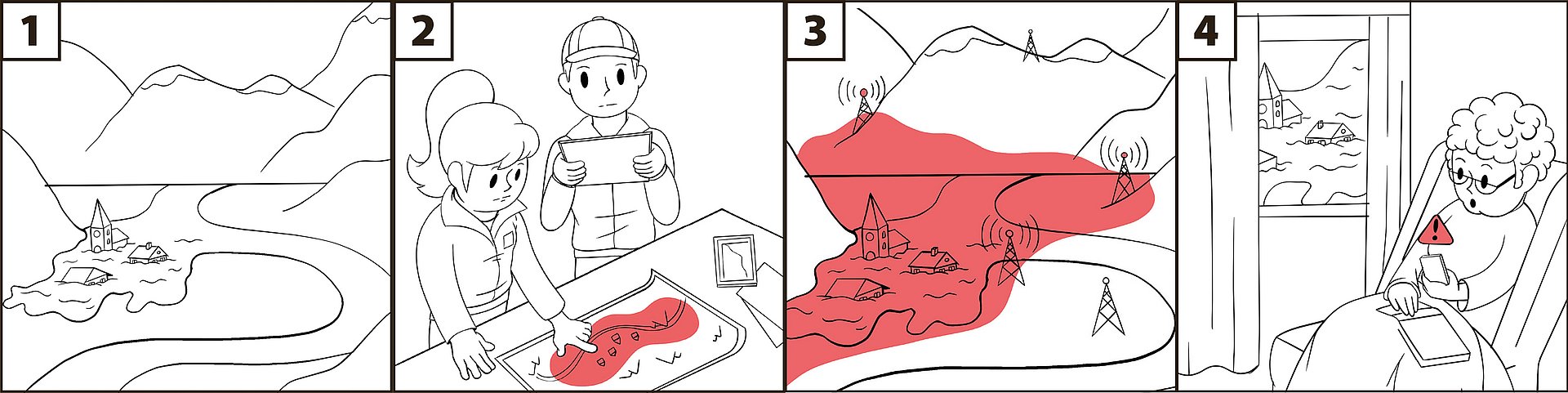
Bildgeschichte zur Funktion von AT-Alert
© Land Tirol
  1. Hazard identified: The authority receives information about a hazard — for example a natural hazard (such as severe weather/flooding) — and decides on triggering AT-Alert (and the warning level).
  2. Affected area defined: The authority defines the area to be warned (e.g., within a municipality, region, or the entire province) and writes the alert message and instructions.
  3. Warning sent via the mobile network: AT-Alert is sent via the mobile network operators to the mobile phones in the affected area. Specifically, the warning messages are transmitted via base stations to all mobile phones located in a specific section of the mobile network, a so-called radio cell.
  4. Mobile phones in the affected area receive the warning: The mobile phone receives the warning message and displays it (for an Emergency alarm always with an audible signal). The warning is a short text message (in German and English) containing information about the hazard, instructions for action, and a link with further information and additional instructions.

Important: AT-Alert is not an SMS or a push notification. It is a priority message and works even if mobile networks are busy.

How long is an AT-Alert active?

An AT-Alert remains active for as long as the responsible authority considers it necessary. While the alert is active, it continues to be broadcast in the affected area.

This means that if you enter the area later, you will still receive the alert.

When your phone receives an AT-Alert, it displays the message and stores it for 24 hours. If an alert remains active for more than 24 hours, it will be displayed again after this period.

This is not a new alert or an update, but a technical re-display of the same message. The exact timing may vary depending on your phone’s operating system.

FAQ – The most frequently asked questions about AT-Alert

Questions about receiving AT-Alert

Do I have to register or download an app to receive AT-Alert messages?

No. To receive AT-Alert messages, no registration and no app are required. The mobile phone must be ready to receive and have a current operating system (see details here). The highest AT-Alert warning level (Emergency alarm) is enabled by default on all mobile phones. Additional warning levels may need to be enabled in the phone’s settings.

How to activate the additional warning levels:

  • iOS (iPhone): Settings | Notifications | AT-Alert
  • Android: Settings | Safety and emergency | Emergency alerts

(Paths may vary slightly by device/OS version)

Can I switch off the warning messages or unsubscribe from AT-Alert?

No. The highest AT-Alert warning level (Emergency alarm) is enabled by default on all mobile phones and cannot be deactivated. Additional warning levels can be enabled/disabled in the mobile phone’s settings. For your own safety, we strongly recommend activating all warning levels.

Which mobile phones can receive AT-Alert?

All mobile phones with a current operating system can receive all AT-Alert warning levels (Android from operating system version 11; iPhones from operating system version iOS 17.4). This also applies to Apple Watch from Series 4 (with cellular capability). Older devices with at least 2G/GSM can receive the highest warning level (Emergency alarm). iPads are not supported. Due to missing Google services, Huawei devices currently cannot receive AT-Alert messages.

I don’t have an Austrian phone number. Will I still receive an AT-Alert?

Yes. All ready-to-receive mobile phones in the affected area receive AT-Alert messages regardless of the network operator. Roaming users (mobile phones registered abroad) can also receive AT-Alert messages if they are in an area in Austria for which the warning applies and the corresponding warning level is switched on.

How do I receive warnings if I don’t have a mobile phone?

AT-Alert supplements other types of public warning systems such as sirens. In a crisis situation, information is also disseminated via the media — above all radio. Please ensure you always use official channels for information.

Why didn’t I receive an AT-Alert?

There may be several reasons:

  • The mobile phone was not in the affected area.
  • The mobile phone was switched off or in flight mode.
  • The device software is outdated.
  • For Threat information: The warning level was not enabled on the mobile phone.

Note: AT-Alert is activated by the authority and sent by the mobile network operators.

I was not in the affected area but still received a warning. Why?

AT-Alert is transmitted via base stations to all mobile phones in the affected area. However, the pairing between mobile phones and base stations is complex and location-specific: In isolated cases, mobile phones are connected to base stations that are not directly nearby. As a result, some mobile phones may receive the warning message even though they are not in the affected area. The authority cannot influence this. The warning message always states precisely for which area the warning applies.

I received the AT-Alert late, but multiple times — how is that possible?

When the mobile phone receives the AT-Alert, it displays the warning message and stores it for 24 hours. With outdated operating systems, this process may be disrupted. In such cases, the warning message may appear delayed or multiple times. A warning message is automatically deleted by the phone’s operating system after 24 hours. If the official warning still applies, the warning message will be displayed again on the mobile phone. The timing can vary depending on the status of the phone’s operating system.

I dismissed the AT-Alert by mistake. Is the message gone?

AT-Alert warnings can be called up again on the mobile phone after reception.

  • iOS (iPhone): Warnings are visible in the Notification Center as long as they are not deleted.
  • Android: Settings | Safety and emergency | Emergency alerts | Previous warnings (Warnings may also appear in the notification list)

(Paths may vary slightly by device/OS version)

Questions about AT-Alert messages

What should I do if I have received an AT-Alert?

First, read the message carefully. You will immediately receive information about the hazard (where and what) and initial instructions for action. These must be observed. The warning message also contains a link. This link leads to the Province of Tyrol’s warning website, where information is updated continuously.

What does an AT-Alert message contain?

AT-Alert messages are text messages and contain information about what has happened where or what hazard is imminent, as well as, where applicable, instructions for action. A link with further information is also provided.

What warning levels are there with AT-Alert?

AT-Alert messages include various warning levels; in principle (depending on the mobile phone) there are:

  • Emergency alarm
  • Extreme threat
  • Severe threat
  • Threat information
  • Missing persons
  • Test alert
  • Exercise alert

The highest warning level (Emergency alarm) is enabled by default on all mobile phones. Messages with this warning level are played on the mobile phone with a loud tone, even if it is set to silent. The other warning levels can be switched on or off via the settings menu (AT-Alert: activation on the mobile phone). The responsible authority decides which warning level is used to send a message.

Are AT-Alert messages updated?

The warning text displayed on the mobile phone is kept as short as possible and remains the same until the warning message expires. Each transmitted warning message contains a link. Under this link you will find further information and instructions for action, which are updated continuously. In principle, if required, areas not yet warned in the vicinity of the original warning area can be added at any time. Mobile phones that are connected to a cell site in this area will then receive the corresponding warning message.

Can I view AT-Alert messages even if I am not in the affected area?

Via the following website of the Austrian Regulatory Authority for Broadcasting and Telecommunications (RTR), all AT-Alert messages currently active in Austria can be viewed: warnungen.at-alert.at. Previous messages can be found using the filter function.

General questions about AT-Alert

How often is AT-Alert used? Isn’t there already enough warning?

AT-Alert is used deliberately and responsibly. Since its introduction in October 2024, the system has only been used five times in Tyrol (as of early April 2026). Four of these were local events and one was a threat information for all of Tyrol. AT-Alert does not replace, but complements, other types of public warning systems such as siren signals. This also applies to the Province of Tyrol’s push notifications sent via the Land Tirol app (note: unlike AT-Alert, a push notification via the app is always location-independent, provided the app is installed and push notifications are enabled).

Does AT-Alert replace other warnings — such as sirens?

No. AT-Alert does not replace, but complements, other types of public warning systems such as siren signals and communications from the Province or the authority. These continue to exist. With AT-Alert, warnings and instructions for action can additionally be issued more quickly and in a more targeted manner to all those affected. The system is also highly fail-safe.

How does AT-Alert work?

AT-Alert is based on Cell Broadcast technology. Cell Broadcast is a technology standard of modern mobile networks that enables written messages (e.g., safety-relevant information, warnings) to be sent directly to mobile phones in a specific, geographically defined area. The warning messages are transmitted via the base stations/mobile network to all mobile phones that are connected to a cell site within a specific area.

Who sends AT-Alert messages?

The triggering bodies for AT-Alert are the nine state warning centres of the federal states and the Federal Ministry of the Interior. In a digital system, the triggering bodies select the affected area and create a message text. This information is automatically transmitted to the mobile network operators and sent in the mobile network cells of the affected area to all registered mobile phones.

When is AT-Alert triggered?

Messages can be sent for any event if the competent authority (e.g., a municipality or the Province of Tyrol) considers this appropriate in view of imminent or spreading major emergencies or disasters. Examples of possible triggering events are:

  • (Life-)threatening natural hazards (severe weather such as storms, extreme heavy rainfall, extreme flood risk, extreme snowfall, very high avalanche risk, extreme forest fire risk, …)
  • (Life-)threatening technical hazards (incidents involving radiological, biological and chemical substances, such as gas leaks, chemical leaks, explosion hazards, but also hazards from smoke gases, supply crisis/contamination of drinking water or food, failure of emergency numbers, …)
  • (Life-)threatening police situations
How fail-safe is AT-Alert?

When implementing AT-Alert, great importance was attached to a high level of redundancy in order to make this important system as fail-safe as possible. AT-Alert depends on a functioning mobile network.

How does AT-Alert differ from SMS or push notifications?

Warning messages via Cell Broadcast (such as AT-Alert) utilise the reception capability of mobile phones in a specific area and are an anonymous way of transmitting information. This means that mobile phones in a potential affected area can be reached without users having to register or provide personal data beforehand. In contrast, an SMS is a direct message addressed to a specific person. To receive an SMS, the recipient’s mobile phone number must be known. This means that an SMS-based warning system can only reach people who have previously registered with their phone number. For push notifications, registration/consent is required — for example via an app.

How are users protected from false messages?

The highest security standards (including the use of certificates for data transmission) ensure that only the triggering bodies can send messages via AT-Alert on behalf of or for the responsible authorities. Each AT-Alert message indicates the office from which it was sent. All active AT-Alert warnings can be viewed at warnungen.at-alert.at.

How is data protection guaranteed with AT-Alert?

The mobile phone technology Cell Broadcast, on which AT-Alert is based, guarantees complete anonymity due to the way it works. No personal data is requested or used. The warning texts are sent via the control channel of the mobile radio cells. There is no feedback, so receiving a message via Cell Broadcast is similar to receiving a radio broadcast. The triggering body has no information about the mobile phones reached, nor about any personal data of mobile phone users.

Kontakt

Landes-Warn- und Lagezentrum Tirol

Eduard-Wallnöfer-Platz 3
6020 Innsbruck
  • Routenplaner
  • +43 512 508 2270
  • lwz@tirol.gv.at
  • Kontaktformular
  • Termin vereinbaren

Telefonbuch des Landes Tirol

Suche nach:

Erweiterte Suche | Organigramm

Haben Sie gefunden, wonach Sie gesucht haben?

Rechtsverbindlicher Kontakt

Für eine gesicherte elektronische Kommunikation mit der Behörde verwenden Sie bitte die Online-Formulare unter www.tirol.gv.at/formulare. Bei zahlreichen Online-Formularen bieten wir Ihnen auf der Abschlussseite eine Eingangsbestätigung zum Herunterladen an. Weitere Informationen zur rechtswirksamen Einbringung finden Sie unter www.tirol.gv.at/einbringen.

Nicht rechtsverbindlicher Kontakt

Datenschutzrechtliche Information nach Art. 13 DSGVO:

Die von Ihnen auf dieser Seite angegebenen Daten werden von uns zum Zweck der weiteren Bearbeitung Ihres Anliegens sowie für allfällige Rückfragen verarbeitet. Nähere Informationen zum Datenschutz finden Sie unter www.tirol.gv.at/datenschutz.

Vielen Dank für Ihr Feedback!

Wenn Sie uns dennoch schreiben wollen, besuchen Sie hierfür unsere Kontaktseite.

Kontakt

Amt der Tiroler Landesregierung
Eduard-Wallnöfer-Platz 3, 6020 Innsbruck
  • Telefon: +43 512 508
  • E-Mail: post@tirol.gv.at

Bürgerservice

  • Beauftragte Gutachten, Studien und Umfragen
  • Ausschreibungen
  • Bote für Tirol
  • Dienstleistungsservice - EAP
  • Digital in Tirol
  • Förderungen
  • Landesgesetze, Verordnungen und Richtlinien
  • Rechtliche Informationen / Kundmachungen
  • Landesverwaltungsgericht Tirol
  • Newsletter
  • Online-Formulare
  • Karriereportal
  • Datenschutz

Themen

  • Arbeit & Wirtschaft
  • Bauen & Wohnen
  • Bildung
  • Europa & Internationales
  • Gesellschaft & Soziales
  • Gesundheit & Vorsorge
  • Kunst & Kultur
  • Landesentwicklung
  • Landwirtschaft & Forstwirtschaft
  • Sicherheit
  • Sport
  • Statistik & Budget
  • Tourismus
  • Umwelt
  • Verkehr

Bezirke und Gemeinden

  • Bezirkshauptmannschaft Imst
  • Bezirkshauptmannschaft Innsbruck
  • Bezirkshauptmannschaft Kitzbühel
  • Bezirkshauptmannschaft Kufstein
  • Bezirkshauptmannschaft Landeck
  • Bezirkshauptmannschaft Lienz
  • Bezirkshauptmannschaft Reutte
  • Bezirkshauptmannschaft Schwaz
  • Stadtmagistrat Innsbruck
  • Abteilung Gemeinden
  • Gemeinden Tirols
  • Gemeinde-Investitionsfonds (GIF)
  • Pressemeldungen

Regierung

  • Anton Mattle
  • Philip Wohlgemuth
  • Josef Geisler
  • Mario Gerber
  • Cornelia Hagele
  • Astrid Mair
  • Eva Pawlata
  • René Zumtobel

Landtag

  • Übersicht
  • Meldungen
  • Willkommen
  • Der Tiroler Landtag
  • Sitzungen
  • Live
  • Petitionen
  • Parlamentarische Materialien
  • Adlerohren
  • Landesrechnungshof
  • Landesvolksanwältin
  • Wissenswertes & Service

Verwaltung

  • Telefonbuch
  • Innerer Dienst
  • Organisationseinheiten
  • Einrichtungen des Landes Tirol

Presse

  • Podcast „ins Land einihören"
  • Pressemeldungen
  • Öffentlichkeitsarbeit
  • Medienverzeichnis
  • Tiroler Landeszeitung

Meta

  • Impressum
  • Datenschutz
  • Barrierefreiheitserklärung
  • Selbstbeschreibung unserer Barrierefreiheit
  • Compliance & Korruptionsprävention
  • Portal Tirol
  • RSS
  • Service & Kontakt
  • Unser Land Tirol auf Instagram
  • Unser Land Tirol auf Facebook
  • Unser Land Tirol auf YouTube
  • Unser Land Tirol auf Twitter
  • Unser Land Tirol auf TikTok